
Every year, more than 10 million pets go missing across the United States.
Of those, a large portion end up in shelters — scanned, identified, and then… stuck. Not because the technology failed. Because the system behind it was never completed.
A microchip is only half the story. What happens when a vet or shelter scans your pet's microchip determines whether your dog or cat comes home or doesn't.
A microchip implanted in your dog or cat is about the size of a grain of rice. And yet, it's the single most reliable tool for reuniting lost pets with their owners — with one condition: the system behind it has to be set up correctly.
This guide walks you through the full biological, technical, and administrative chain that unfolds in those critical moments, and what you can do right now to make sure it works when it needs to.
Before getting into what happens at the vet, it helps to understand what you're actually dealing with.
A pet microchip is a passive RFID (radio-frequency identification) transponder.
Passive means no battery, no power source, no active signal. The chip sits completely dormant inside your pet's body until an external reader activates it. It doesn't emit anything on its own, which is also why it cannot track location.
The chip is encased in biocompatible borosilicate glass — the same category of material used in medical implants. It's implanted with a needle, typically between the shoulder blades, in a procedure that takes seconds and requires no anesthesia.
What the chip stores: One thing only: a unique numeric ID. In the US, this is most commonly a 15-digit number conforming to the ISO 11784/11785 standard.
What it does not store: Your name, address, phone number, your pet's name, breed, vaccination history or any other information.
That's it. No location data. No owner name. No medical history. Just a number.
Register with the National Microchip Registry today → one time, for life.
This is the core question and it unfolds in a specific sequence that most pet owners have never seen.
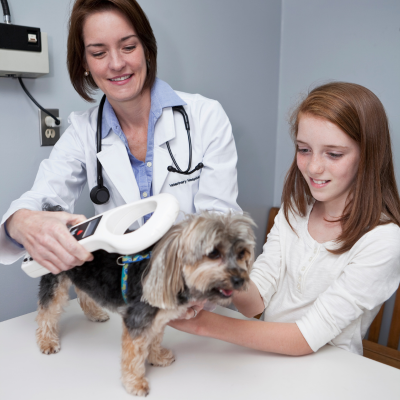
When a found or injured animal arrives at a veterinary clinic or animal shelter, a technician runs a handheld RFID scanner over the animal's body.
The scanner emits a low-frequency electromagnetic field, typically at 134.2 kHz, the ISO international standard.
When that field reaches the implanted chip, it energizes the chip's internal coil just long enough to broadcast its stored ID number back to the reader.
The entire transmission takes a fraction of a second. The number appears on the scanner's display. Here's what that sequence looks like in practice:
|
Step |
What Happens |
|---|---|
|
1. Physical scan |
Scanner passes over pet's neck, shoulder blades, and sides in an S-pattern |
|
2. Signal activation |
RFID field powers the chip; ID number transmits |
|
3. Number displayed |
Unique ID appears on scanner screen |
|
4. Registry lookup |
Number is entered into a pet microchip lookup database (often AAHA Universal Lookup) |
|
5. Owner match |
Database returns name, phone, and contact info — IF the chip is registered |
|
6. Owner contact |
Shelter or vet calls the owner directly |
The scan is nearly instantaneous. But if the chip isn't registered in an accessible database, the process stops there.
This is why the National Microchip Registry (NMR) recommends all pet owners test their chip once a year.
What shows up on screen when a microchip is scanned:
What does NOT show up:
Your contact information lives in a pet microchip registry, a separate database that links that ID number to your account.
This two-part structure is intentional.
It protects owner privacy, but it also creates a dependency: the registry record has to exist, and it has to be current, for the chip to be useful.
The most widely used cross-registry lookup tool in the US is the AAHA Universal Pet Microchip Lookup, which searches multiple participating databases simultaneously.
This is where lost pet reunification fails — not at the scanner, but at the lookup.
If your pet's chip is unregistered, that scan at the vet produces a number with no attached identity. The technology worked — the system failed.
When shelter staff enter an ID number and no registration record appears, a few things happen:
The most direct solution and the one that takes two minutes is registering your chip in a centralized, always-accessible database.
National Microchip Registry (NMR) is an AAHA-recognized platform that allows shelters and veterinary staff to reach your contact details instantly, 24 hours a day, from any device.
Chips most commonly migrate downward or laterally which is why thorough technique matters, particularly in cats and small dogs.
If you want to confirm your pet's chip number at home between vet visits, the most reliable option is a vet or shelter courtesy scan.
Many clinics will do this at no charge. Searching "microchip dog near me" or calling your local shelter is often the fastest way to find one.
It's worth addressing the concerns directly, because they're real even if they're often overstated.
Some owners cite concerns about health risks, privacy, or the belief that their pet is safe enough without one.
The data, however, puts the risk calculus in sharp relief: microchipped dogs are returned to their owners at a rate of 52.2% compared to 21.9% for unchipped dogs. For cats, the gap is even larger — 38.5% vs. 1.8%.
No microchip is a risk. A registered one is a safety net.
Start your pet's registration here →
This is a question with a precise answer: typically 1–4 inches (2–10 cm) under optimal conditions, depending on scanner quality and chip type.
RFID pet chips are not long-range devices. The electromagnetic coupling between chip and scanner requires close proximity. The scanner must pass directly over or very near the implant site.
This is why scanning protocol matters:
The short read range is intentional —these chips are designed for identification, not surveillance. A chip cannot be read through a wall, from a passing vehicle, or by any remote device.
Check your pet's current registration status at NMR →
DIY microchipping is not recommended and is illegal to perform without a veterinary license in most US states.
The chip must be implanted at the correct depth and location, verified by a post-implant scan, and documented in veterinary records. An improperly placed chip can migrate rapidly, fail to scan, or in rare cases cause tissue complications.
The procedure is roughly equivalent to a standard vaccine injection in terms of discomfort. Most pets show minimal reaction.
If you're looking for dog microchipping near me, your primary care veterinarian is the starting point.
Verify and update your contact details at nmr.pet — particularly after a move, a phone number change, or any change in household.
No — and this is one of the most persistent misunderstandings about the technology.
A veterinarian, shelter, or registry cannot use a microchip to determine your pet's current location. There is no tracking function, no GPS component, and no way to ping the chip remotely. It is purely a passive identification device.
What a vet can do:
What a vet cannot do:
If real-time location tracking is your goal, a GPS collar device which is an entirely separate category of technology would serve that purpose. Microchipping and GPS tracking are complementary, not interchangeable.
A study published in the Journal of the AVMA found that among microchipped pets in shelters that were not reunited with owners: The largest single cause of failed reunion isn't an unregistered chip — it's an outdated phone number attached to a registered one.
Update your contact information in the NMR database →
Getting your pet chipped is step one. Registering the chip is step two. Keeping that registration current is a continuous responsibility — not a one-time task.
The scan at the vet lasts one second. The registry record that makes that scan meaningful needs to be accurate for the life of your pet.
NMR's lookup tool is accessible to veterinary staff, shelter workers, and animal control officers across the US at any hour.
If your pet's chip is registered with NMR and your contact information is current, that one-second scan becomes a direct line back to you.
.